

Last Updated: October 25, 2026
Quick Summary
The best spiritual guidebooks for women meet you where you are, name what you're carrying, and give you something to do on Monday morning. Judge each title by five checks: a named method, sourced lineage, exercises with instructions, honest scope, and content notes. The right book fits your nervous system, history, and current energy rather than being the most popular one.
- Run every title through five checks, including a named method and sourced lineage.
- Start beginners with one practice, not a system, and chapters under fifteen pages.
- A four-week beginner plan previews content notes first and adds exercises in week two.
- Trauma-informed books give permission to stop, skip, or adapt exercises.
- Discernment, asking whether a practice calmed or activated you, is the step most readers skip.
Table of Contents
- How to Choose the Best Spiritual Guidebooks for Women
- Spiritual Books for Beginners: Where to Start Without Overwhelm
- Divine Feminine Spirituality Books: Archetypes, Myth, and the Sacred Feminine
- Healing Self-Help Books for Women: Trauma-Informed Reading for Emotional Wellbeing
- Feminist Spirituality Books: Inclusive Perspectives and Women's Spiritual Journeys
- How to Use a Guidebook: Exercises, Reflection, and Discernment
- Frequently Asked Questions
How to Choose the Best Spiritual Guidebooks for Women
The best spiritual guidebooks for women meet you where you are, name what you're carrying, and give you something to do on Monday morning.
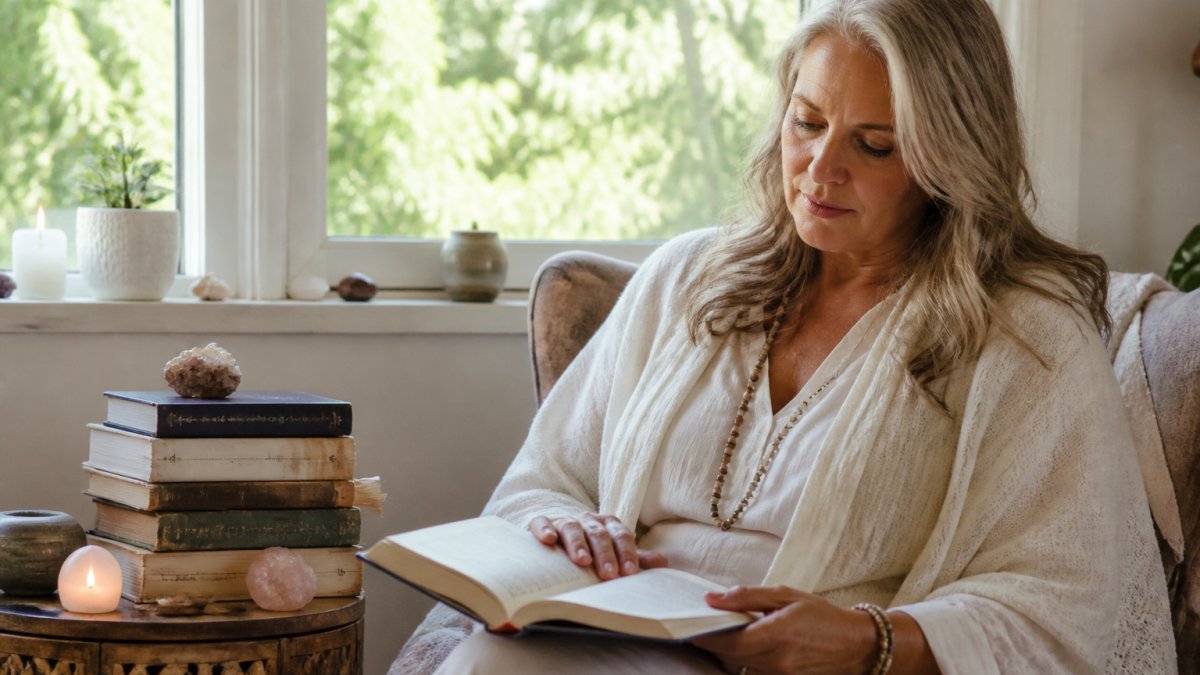
The right book isn't the most popular one, it's the one whose method fits your nervous system, history, and current energy.
One useful benchmark: the Women's Spirituality Program at the California Institute of Integral Studies selected 100 books in women's spirituality to honor and donated them to the CIIS Library.
Selection Criteria That Separate Substance from Repackaged Content
A guidebook earns its place on your shelf when it passes five checks. Run every title through this list before you buy:
- Named method. The author describes a specific practice, not vague "energy work."
- Sourced lineage. The tradition, teacher, or research behind the method is stated plainly.
- Exercises with instructions. You can follow the steps without guessing.
A book can be sincere and still wrong for you: a gentle devotional and a shadow-work manual are both legitimate, but not interchangeable. The biggest red flag is a guidebook promising a fixed outcome in a fixed number of days, real inner work doesn't run on a countdown.
Content Notes: Matching a Book to Your Nervous System
Content notes are short statements about what a book contains and how it may affect a reader. They matter most for anyone healing from religious harm, anxiety, or burnout. A book that asks you to sit with grief for an hour a day is not the same as one that asks for five minutes of journaling.
Ask three questions before you start:
- Does this practice calm me or activate me?
- Can I stop midway without guilt?
- Does the author respect my right to say no?
If a book pushes past a no, put it down. Discernment is a skill every guidebook should build, not override.
Spiritual Books for Beginners: Where to Start Without Overwhelm
Spiritual books for beginners should be short, structured, and low-pressure. The goal of a first book isn't transformation but building a habit you can keep, and the fastest way to lose it is a 400-page esoteric tome that assumes you already know the vocabulary.
Start with one practice, not a system. A single daily reflection beats a twelve-part curriculum you abandon in week two. Look for chapters under fifteen pages with one exercise each, finishing something builds trust in yourself.
A common mistake is buying five books at once. Read one, finish it, then choose the next based on what you actually needed more of. Beginners also do well with books that explain their own vocabulary, so you aren't left decoding terms like 'shadow,' 'archetype,' or 'grounding' alone.
Beginner-Friendly Titles Worth Starting With
These guidebooks pass the five selection checks above and suit a first or returning reader. Publication details are included so you can check your library or audiobook app before buying.
- Julia Cameron, The Artist's Way (1992, TarcherPerigee; roughly 270 pages; widely available in paperback, ebook, and audiobook). A twelve-week structure built around 'morning pages' and a weekly 'artist date.' It is framed as creativity recovery rather than spirituality, which makes it a gentle entry point for readers who feel allergic to the word 'spiritual.' Best for readers who want a fixed weekly rhythm. Skip if you dislike homework-style prompts.
- Anne Lamott, Help, Thanks, Wow: The Three Essential Prayers (2012, Riverhead; about 110 pages; paperback, ebook, audiobook). Short, essay-based, and explicitly non-doctrinal. A good fit for readers returning to practice after religious harm because Lamott writes about prayer without insisting on a specific tradition. Best for readers who want reflection over exercises. Skip if you want structured practices.
- Pema Chödrön, When Things Fall Apart (1997, Shambhala; roughly 160 pages; paperback, ebook, audiobook). Rooted in Tibetan Buddhist teaching but written for lay readers. Chapters are short and each stands alone, which suits readers with limited energy. Best for readers drawn to contemplative practice. Skip if you want a workbook format.
A Beginner Reading Plan That Actually Sticks
Instead of reading straight through, try this four-week structure with any title above:
| Week | What You Do | Time per session |
|---|---|---|
| 1 | Read the introduction and any content notes; do not start exercises yet | 15 min, twice |
| 2 | Read one chapter and do its exercise once | 15-20 min, three times |
| 3 | Repeat the same exercise on different days and journal one paragraph each time | 10 min, three times |
| 4 | Read the next chapter; decide whether to continue, pause, or switch books | 15 min, twice |
This plan is deliberately slow: the point of a first guidebook is to prove you can keep a practice, not to finish a book.
Best for: readers returning to spiritual practice after time away, or anyone who feels behind. Skip if: you already have a steady practice and want depth, not structure.
Divine Feminine Spirituality Books: Archetypes, Myth, and the Sacred Feminine
Divine feminine spirituality books explore the sacred feminine through myth, story, and feminine archetypes rather than doctrine, image and narrative suit readers who feel lectured by rule-based texts. Look for books that name their sources: folklore, goddess traditions, and myth cycles carry real cultural roots, and transparency about where a story comes from separates study from pastiche.
Best for: readers drawn to story, symbolism, and reflection over instruction. Skip if: you want a step-by-step program with measurable milestones.
Healing Self-Help Books for Women: Trauma-Informed Reading for Emotional Wellbeing
Healing self-help books for women work best when they are trauma-informed: the author understands that healing, trauma, and anxiety don't follow a schedule, and the book tells you up front what it contains, a reader healing from religious harm or burnout deserves to know before page one whether a chapter will ask her to sit with grief for an hour.
Trauma-informed reading has a few visible markers:
- Permission to stop, skip, or adapt exercises
- No shaming language about 'resistance'
- Grounding practices before deep reflection
Self-compassion is the thread here: books that frame healing as kindness serve readers better than books that frame it as discipline.
One honest limitation: no book replaces professional support. A guidebook is a companion, not a clinician. If a title claims to heal trauma on its own, close it.
Trauma-Informed Titles and Their Content Notes
These guidebooks are widely recommended in trauma-aware reading circles. Each entry includes a plain content note so you can judge the fit before you begin.
- Bessel van der Kolk, The Body Keeps the Score (2014, Viking; roughly 440 pages; paperback, ebook, audiobook). A research-grounded book on how trauma is stored in the body. Content note: contains detailed accounts of trauma, including childhood abuse and war trauma; some readers find the case studies activating. Best for readers who want to understand the mechanism of trauma. Skip if you need a practice-first book rather than an explanatory one.
- Gabor Maté, When the Body Says No (2003, Knopf Canada; about 320 pages; paperback, ebook, audiobook). Explores the link between stress, emotion, and illness (pubmed.ncbi.nlm.nih.gov). Content note: discusses chronic illness, grief, and family dynamics; not a workbook. Best for readers who want to understand how stress lives in the body. Skip if you want guided exercises.
- Tara Brach, Radical Acceptance (2003, Bantam; roughly 350 pages; paperback, ebook, audiobook). Blends Buddhist practice with Western psychology, with guided reflections at the end of chapters. Content note: includes stories of shame and grief; exercises are optional and can be shortened. Best for readers who want a practice-based book with a gentle tone. Skip if you want a strictly secular framing.
How to Read a Healing Guidebook Without Overwhelming Yourself
A few practical rules help highly sensitive readers and anyone in active healing:
- Read the introduction and any content notes before starting chapter one.
- Shorten every exercise to half the suggested time for the first two weeks.
- Keep a grounding practice (slow breathing, a walk, a familiar song) available after each session.
Best for: readers who want to understand healing and have a practice to return to. Skip if: you are in acute crisis or want a book that promises a fixed timeline; those are signs to seek professional support instead.
Feminist Spirituality Books: Inclusive Perspectives and Women's Spiritual Journeys
Feminist spirituality books ask who got to write the tradition, and who was left out, widening women's spiritual journeys to include voices across cultures, ages, and life experiences. They're strong on empowerment and personal development because they connect inner work to outer context, work, family, and money included.
Best for: readers who want their spiritual growth to engage real-world questions. Skip if: you're looking for a tradition-specific devotional with no social framing.
How to Use a Guidebook: Exercises, Reflection, and Discernment
A guidebook only changes anything if you use it. Here is the method we recommend, and it works for any title you pick up.
| Step | What You Do | Time | How Often |
|---|---|---|---|
| 1. Preview | Read the intro and content notes | 15 min | Once |
| 2. Set scope | Pick one exercise per week | 5 min | Weekly |
| 3. Practice | Do the exercise, no skipping ahead | 10-20 min | 3x per week |
| 4. Reflect | Journal one page on what shifted | 10 min | Weekly |
| 5. Discern | Ask: did this calm or activate me? | 5 min | Monthly |
| 6. Decide | Continue, pause, or set the book down | 5 min | Monthly |
Discernment is the step most readers skip. It's also the one that protects you. A guidebook that makes you feel worse about yourself week after month is not a growth tool, whatever its cover says.
Highly sensitive readers should shorten every session and protect quiet time afterward. There's no prize for pushing through.
Choosing the best spiritual guidebooks for women comes down to one act of honesty: admitting what you actually need right now, not what you wish you needed. If you want a curated starting point, Sovereign Soul .Store offers digital guidebooks, reflection bundles, and an AI-powered guidance app built around spiritual sovereignty and discernment, with resources that address religious manipulation and support both personal and business growth.
Frequently Asked Questions
What should a beginner read to explore spirituality?
Start with one accessible spiritual guidebook rather than a stack. Look for a book that explains foundational ideas in plain language, includes reflection prompts, and does not require prior knowledge of esoteric terms. Beginner-friendly spiritual books for women often combine personal story with practical exercises, which makes the material easier to apply. Read one chapter at a time and journal afterward. If a book introduces womb spirituality, auras, or spiritual laws too quickly, set it aside and return when you have more context.
How can I choose a spiritual book that fits my beliefs?
Check three things before buying: the author's tradition, the book's stated audience, and whether it includes content notes. A feminist spirituality book may center women's lived experience and social context, while a divine feminine spirituality book may focus on archetypes and myth. Neither is wrong, but they serve different needs. Read the introduction and table of contents, look for sample pages, and notice whether the language respects your own values. Discernment matters more than popularity.
Are there spiritual guidebooks focused on healing and personal growth?
Yes. Healing self-help books for women increasingly address trauma, anxiety, and emotional exhaustion alongside spiritual practice. Look for authors who name their scope clearly, avoid promising instant transformation, and include grounding or self-compassion exercises. A good guidebook supports reflection and transformation without pressuring you to relive painful material. If you are dealing with religious trauma specifically, choose resources that discuss spiritual manipulation and discernment openly, and pair reading with professional support where needed.
What are some of the best books on divine feminine energy?
The strongest divine feminine spirituality books combine myth and story with practical reflection. Look for titles that explore feminine archetypes, the sacred feminine across traditions, and women's spiritual journeys without flattening cultural differences. The Women's Spirituality Program at the California Institute of Integral Studies selected 100 books in women's spirituality to honor and donated them to the CIIS Library, which is a useful starting point for building a reading list. Choose one book that matches your experience level and read it slowly.
